Quick answer: Facebook ads usually take 2 to 4 weeks to stabilize and about 60 to 90 days to show reliable results. The first week or two is a "learning phase" where costs run high while Meta figures out who buys. Cold traffic (people who've never heard of you) typically converts at around 1%, so early results look weak even when the campaign is on track.
Most small businesses don't fail at cold advertising. They quit it about three weeks too early.
The pattern is the same every time. A brand launches its first Meta or Google campaign, checks Ads Manager every morning, sees a few clicks and no sales, and decides ads "don't work for us." In reality the campaign was still in the phase where it's supposed to look bad.
This post covers what to realistically expect when you start advertising to people who have never heard of you: the numbers, the timeline, and the strategies that actually hold up. The examples come from small businesses I've worked with this year, from a handmade furniture maker to a Swiss accounting firm. Names are left out, the lessons aren't.
What conversion rate should you expect from cold traffic?
Cold traffic is anyone who doesn't know your brand yet. They weren't looking for you. You interrupted their scroll. That makes them the hardest visitors to convert, and the 2026 numbers show it.
| Traffic type | Typical 2026 conversion rate |
|---|---|
| Email and referral | ~4% to 5% |
| Average ecommerce store (all traffic) | ~1.4% to 3% |
| Google Search ads (clicks to leads or sales) | ~4% to 8%, varies a lot by industry |
| Cold paid social (Meta prospecting) | ~0.7% to 1.2% |
Sources: eightx, 2026, Krishaweb, 2026, Search Engine Journal / WordStream, 2026, Visionary Marketing, 2026
So if your store converts at 2% overall, don't expect your first Meta campaign to hit 2%. Something closer to 1% is normal. Retargeting the same people later typically converts 3x to 5x better than the first cold touch (Krishaweb, 2026).
It's also getting more expensive to reach people. Meta CPMs (the cost to show your ad 1,000 times) rose about 20% across every industry in 2025 (Influee, 2026). The upside: click-through rates rose too, so better creative is the main lever that offsets higher costs.
The takeaway: cold ads are a discovery tool first. Their job early on is to find the right people and feed them into the rest of your funnel, not to pay for themselves on day one.
What is the Facebook ads learning phase?
Every new Meta ad set starts in a "learning phase." The algorithm doesn't know who will buy yet, so it spends part of your budget testing different people, placements and times. Meta's long-standing rule of thumb is about 50 conversions in 7 days per ad set to get out of it (AdManage, 2026).
During that phase, cost per result commonly runs 20% to 50% higher than where it eventually settles (AdAdvisor). That's the price of the algorithm learning, not a sign the campaign is broken.
Here's the math most small brands never do:
Daily budget to exit learning ≈ (cost per conversion × 50) ÷ 7
If a sale costs you $40 to get, exiting learning on purchases takes about $285 a day. Most small businesses I work with start at $10 to $100 a day. That's fine, but it means two things:
- You probably won't "exit learning" on purchases early, and Ads Manager will say "Learning limited." That's a budget reality, not a penalty.
- You may want to optimize for an earlier step that happens more often, like add to cart or initiate checkout, so the algorithm gets enough signal to learn from.
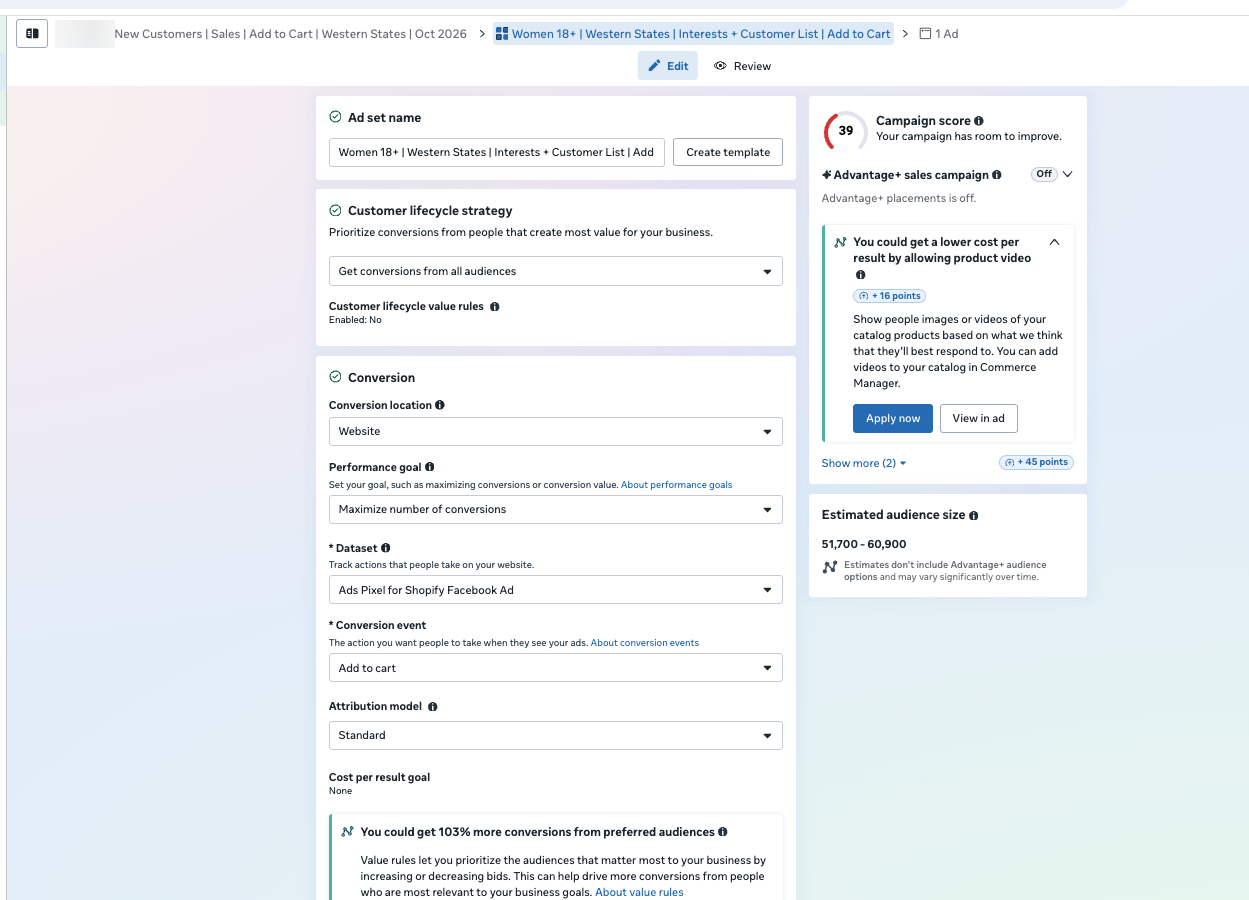
One caveat: every significant edit (new ads, big budget changes, new audiences) resets learning. Patience is part of the strategy.
A realistic 90-day timeline for new ad campaigns
| Period | What's happening | What to judge it on |
|---|---|---|
| Weeks 1 to 2 | Tracking verified, campaigns launch, algorithm explores. Costs run high. | Is tracking firing correctly? Are ads getting impressions and clicks at a reasonable cost? |
| Weeks 3 to 6 | Early winners show up. Weak ads and audiences get cut. Retargeting pools start to fill. | Click-through rate, cost per click, add to carts or leads, which creative is pulling |
| Weeks 7 to 12 | Budget shifts toward what works. Retargeting starts closing cold visitors from earlier. | Cost per sale or lead, blended revenue vs. spend, trend over time |
The biggest mistake is judging month one by month three's standards. In the first few weeks you're buying data. By month three you should be buying customers. (When you get there, here's how to tell if you're ready to increase spend.)
7 strategies that work when you're starting cold
1. Fix tracking before you spend a dollar
A Swiss accounting firm came to me wanting Google Ads leads. Their site had no conversion tracking, no Google Analytics and no tag manager. Launching ads there would have meant spending money with no way to tell which clicks became clients. Step one wasn't a campaign. It was getting tracking installed.
This matters even more for cold traffic, because the algorithm learns from conversion data (more on diagnosing tracking problems). If your pixel misses sales, Meta sees fewer conversions than really happened and learns slower. Server-side tracking (Meta's Conversions API, Google's enhanced conversions) helps recover what browser tracking misses (Adtribute).
2. Count the sales that happen off your website
A handmade furniture maker I worked with sells tables in the thousands of dollars. A big share of those orders never touch the website checkout. Shoppers browse, ask questions, then pay a custom invoice. On paper, the ads looked weak. In reality, ad-driven visitors were buying offline.
The fix was sending paid invoices back to Google Ads as offline conversions. If you sell high-ticket or custom work, don't judge cold ads on in-platform numbers alone.
3. Start where intent already exists
For that same furniture maker, the strongest setup was simple: Google Search catches people already looking for things like a white oak dining table, then Meta retargets those site visitors. A smaller slice of budget goes to cold Meta prospecting using interests like competing furniture brands.
If your budget is small, put the first dollars where people are already searching. Use cold social to widen the top of the funnel once that's working.
4. Keep the structure simple on a small budget
A new women's western boutique launched at $10 a day with a hard spend cap. One campaign, one ad set, six ads mixing video, carousels, a catalog ad and a single static. The rule: no changes to the ad set for the first seven days, and a set weekly check-in after that.
At that budget, splitting money across five ad sets just means five ad sets that never learn anything. Consolidate, let it run, then decide.
5. Make creative that looks real
The boutique owner had one firm rule: nothing that looks AI-generated or fake. That instinct is right. Cold audiences scroll past anything that feels like an ad. Real product shots, styled flat lays and short video from actual shoot days usually beat polished stock-style creative. Higher click-through rates also lower what you pay per click.
6. Set the money expectation up front
With a small-batch candy maker, I said it plainly before any ads ran: paid ads likely won't pay for themselves at first. If return on spend is the priority, cheaper wins come first: fixing the site, email capture, and search visibility. Then ads amplify a funnel that already converts.
That conversation is better before launch than after the first invoice.
7. Give a brand-new account time
A new golf apparel brand starting with a fresh ad account and about $1,000 a month has zero history: no pixel data, no past buyers, no audiences. Expect the first month to be mostly learning which products, messages and people respond. That data is what month two is built on.
Mistakes that kill new campaigns
- Editing every day. Each big change restarts learning. Set a check-in schedule and stick to it.
- Spreading a small budget too thin. Ten ad sets at $10 a day each learn nothing. One or two learn something.
- Judging on in-platform ROAS alone. Offline sales, phone orders and repeat buyers often don't show up in Ads Manager.
- Skipping retargeting. Cold ads plant the seed. Retargeting usually closes the sale.
- Counting your own test orders. Test purchases from setup can inflate early numbers. Exclude them before you report results.
- Quitting at week three. That's usually right when the data starts getting useful.
How to tell if your ads are working in the first 30 days
In the first 30 days, a healthy cold campaign shows:
- Tracking that matches reality (orders in your store roughly line up with what platforms report)
- Click costs trending flat or down, not up
- At least one ad clearly outperforming the rest
- Growing retargeting audiences
- Early-funnel actions (add to carts, checkouts, form fills) even before sales
If those are moving the right way, keep going. If tracking is broken or nobody is clicking, fix that before adding budget.
Thinking about running ads for the first time? I offer paid media audits for small businesses. You'll get a clear picture of what's set up, what's missing, and what a realistic first 90 days looks like for your budget. Start a conversation.
FAQ
How long do Facebook ads take to work?
Most campaigns need 2 to 4 weeks to get through the learning phase and settle, and 60 to 90 days to show dependable results. Small budgets take longer because the algorithm gets less data each week.
How much should a small business spend on Facebook ads to start?
Many small businesses start at $10 to $50 a day. That's enough to learn which ads and audiences respond, but often not enough to exit the learning phase on purchases. Optimizing for add to cart or checkouts can help.
Why are my Facebook ads getting clicks but no sales?
Cold traffic converts at roughly 0.7% to 1.2%, so 100 clicks may produce one sale or none. Check that tracking works, then make sure retargeting is in place to bring those visitors back.
What does "Learning limited" mean on Facebook ads?
It means the ad set isn't getting the roughly 50 conversions a week Meta wants to finish learning. It's usually a budget or conversion-volume issue, not a penalty.
Should I start with Facebook ads or Google ads?
If people already search for what you sell, Google Search is often the better first dollar because it captures existing intent. Facebook is better for creating demand and retargeting those visitors.
Sources
- Ecommerce conversion rate by traffic source, 2026 (eightx)
- Website conversion rate benchmarks 2026 (Krishaweb)
- Facebook Ads benchmarks 2026 (Influee)
- Google Ads benchmarks 2026 (Search Engine Journal)
- Google Ads benchmarks 2026 (Visionary Marketing)
- Facebook Ads learning phase guide 2026 (AdManage)
- Learning phase explained (AdAdvisor)
- Learning phase and server-side tracking (Adtribute)